
In-Depth Answers to Frequently Asked Questions About Tungsten Electrodes
Tungsten electrodes may appear to be simple consumables in TIG welding systems, but they involve multiple scientific disciplines, including refractory metal science, electron emission theory, arc physics, fluid mechanics, welding metallurgy, and process control. In high-end manufacturing fields such as pressure vessels, nuclear power, aerospace, semiconductor equipment, and precision automation welding, properly selected and well-prepared tungsten electrodes often define the upper limit of welding quality.
Excellent welders do not only know how to weld but also understand tungsten electrodes in depth. Welding engineers do not only focus on weld results but also on the process details that determine those results. These factors form the technical foundation of high-quality TIG welding.
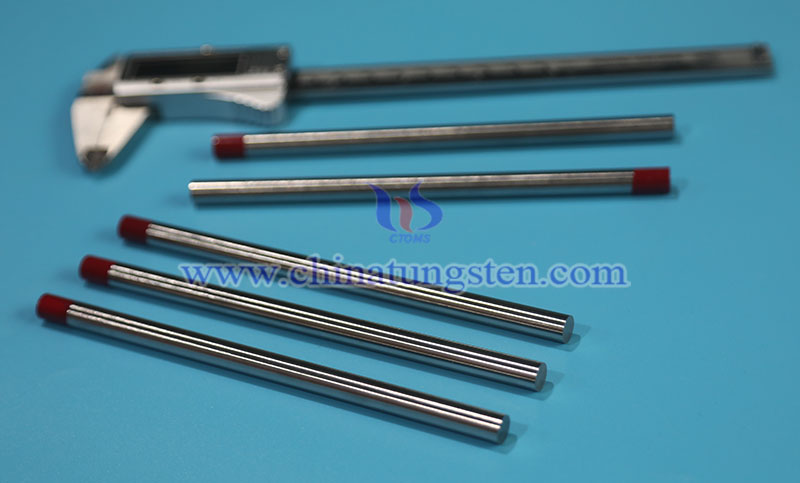
FAQ 1: What’s Tungsten Electrode? Why Not Use Ordinary Metal Electrodes?
Tungsten electrode is a non-consumable electrode made from high-purity tungsten or tungsten doped with rare-earth oxides. It is mainly used in TIG (GTAW) welding, plasma welding, and precision automatic welding systems.
Tungsten (W) is a refractory metal characterized by a melting point of 3422°C, a boiling point of 5555°C, a density of 19.25 g/cm3, a thermal conductivity of approximately 173 W/m·K, and an electron work function ranging from 4.5 to 5.2 eV.
During TIG welding, the core temperature of the arc typically reaches 6000°C to 20000°C. Standard steel (melting point ~1500°C), copper (~1085°C), and aluminum (~660°C) cannot serve as stable electrodes because they melt rapidly under these conditions. Tungsten retains its structural shape and dimensional stability even within extreme high-temperature arc environments.
From a materials science perspective, tungsten features a body-centered cubic (BCC) crystal structure, allowing it to maintain high-temperature strength far better than common metals. This makes it the most industrially mature non-consumable electrode material available. The primary function of tungsten electrode is not to form the weld bead itself, but to: (1) establish and sustain stable arc; (2) conduct welding current to workpiece; (3) stabilize arc shape and energy distribution; (4) ensure uniform heating of weld pool.
Therefore, the quality of tungsten electrode directly influences arc stability, weld bead formation, the incidence of welding defects, and the consistency of automated welding.
A common misconception is that because tungsten is a non-consumable electrode, it experiences zero degradation. In practice, while it does not contribute material to the weld pool, it gradually shortens due to vaporization, burn-off, contamination, and routine grinding.
FAQ 2: Why Is Tungsten Electrode Called Non-Consumable Electrode? Does It Truly Never Melt?
Tungsten electrode is called non-consumable electrode in contrast to the welding wires used in Shielded Metal Arc Welding (SMAW) and Gas Metal Arc Welding (GMAW). This means that during normal welding, tungsten electrode does not act as filler metal to form the weld seam. It only serves to conduct electricity, initiate the arc, and maintain arc stability.
From the perspective of arc physics, the heat in TIG welding mainly comes from the arc discharge process. The current output by the welding machine passes through tungsten electrode, forming a stable arc between the electrode and the workpiece. Electrons move at high speed under the electric field, and their kinetic energy is converted into thermal energy, melting the base material and filler wire.
Throughout this process, tungsten electrode performs four key functions:
(1) Provide stable electron emission source
(2) Establish current conduction path
(3) Control arc shape and energy distribution
(4) Regulate heat concentration in weld pool
Due to its high melting point of 3422°C and superior high-temperature strength, the temperature of the electrode remains below its melting point when correct technical parameters are maintained, preventing it from melting into the weld bead.
Non-consumable does not mean absolutely no melting. Local melting may occur under the following conditions:
(1) The welding current severely exceeds the recommended range for the electrode diameter;
(2) The wrong polarity is selected for AC (Alternating Current) or DC (Direct Current) operations;
(3) The torch cooling capacity is insufficient;
(4) Shielding gas failure causes severe oxidation and burn-off;
(5) The tungsten tip makes direct contact with the molten pool or filler wire.
Once tungsten electrode melts into the weld, it forms tungsten inclusions. Tungsten inclusions not only affect the appearance of the weld but also cause stress concentration, reduce fatigue life, and may lead to failure in radiographic testing.
In aerospace, nuclear equipment, and pressure vessel manufacturing, tungsten inclusions are usually considered serious defects. Once detected, the defective area must typically be completely ground out and re-welded.
The most common misconception about tungsten electrode is that non-consumable electrodes never wear out. In reality, although tungsten electrode does not participate in weld formation, it still gradually shortens due to evaporation, burning, contamination, and repeated grinding. Tungsten electrode is essentially a slow-consumable electrode, not a permanent one.
FAQ 3: What Do Color Codes On Tungsten Electrodes Mean?
A frequent misconception among beginners is that the color on tungsten electrode tip is merely a brand aesthetic. In reality, these colors correspond to the internationally standardized classification systems for tungsten electrodes (such as ISO 6848 or AWS A5.12M), designating the specific rare earth oxide doping system used and the resulting performance characteristics.
While pure tungsten possesses a very high melting point, it suffers from difficult arc ignition, limited current-carrying capacity, and poor arc stability. To overcome these limitations, manufacturers dope high-purity tungsten with trace amounts of rare earth oxides. These additives include thorium oxide (ThO?), cerium oxide (CeO?), lanthanum oxide (La?O?), and zirconium oxide (ZrO?), as well as multi-component composite oxides. These oxides lower the thermionic work function at the electrode surface, allowing electrons to escape into the arc zone with less energy. This improves arc starting, enhances arc stability, and extends electrode longevity.
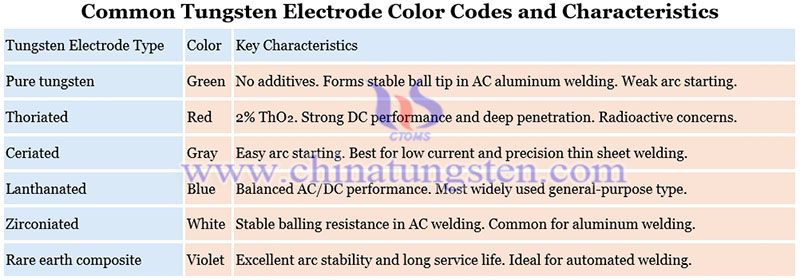
For general manufacturing facilities requiring a single, versatile electrode grade, the lanthanated tungsten electrode (doping with 2% La?O?, blue color code) represents the most practical choice. It combines reliable arc starting, high current capacity, eco-friendly characteristics, and wide process adaptability.
A common misconception is assuming that rare or unique tip colors automatically indicate superior quality. Colors represent optimization for specific welding scenarios rather than a quality tier. Correct selection must always align with the base metal type, welding current parameters, process variant, and power source characteristics.
FAQ 1: What’s Tungsten Electrode? Why Not Use Ordinary Metal Electrodes?
FAQ 2: Why Is Tungsten Electrode Called Non-Consumable Electrode? Does It Truly Never Melt?
FAQ 3: What Do Color Codes On Tungsten Electrodes Mean?
FAQ 4: Which Tungsten Electrode Is The Best?
FAQ 5: Why Is Red-Tip Thoriated Tungsten Electrode Becoming Less Common?
FAQ 6: Why Does Tungsten Electrode Always Form A Ball At The Tip?
FAQ 7: How Sharp Should Tungsten Electrode Be Ground?
FAQ 8: Why Must Tungsten Electrode Be Ground Longitudinally?
FAQ 9: How Long Should Tungsten Electrode Stick Out?
FAQ 10: Why Does Tungsten Electrode Always Touch The Molten Pool?
FAQ 11: What To Do If Tungsten Electrode Is Contaminated? Why Must It Be Reground?
FAQ 12: Why Does The Arc Always Wander?
FAQ 13: How to Select Tungsten Electrode Diameter?
FAQ 14: Why Must Alternating Current (AC) Be Used For Aluminum Welding?
FAQ 15: Must TIG Always Use 100% Argon?
FAQ 16: How Often Should Tungsten Electrode Be Replaced?
FAQ 17: What Is Function of Gas Lens in TIG Welding?
FAQ 18: Can Ordinary Grinding Wheel Be Used For Tungsten Electrode Grinding?
FAQ 19: Why Does Porosity Appear In Weld Bead?
FAQ 20: What Tungsten Electrode Should Beginners Buy?
Engineers’ Top 10 Golden Experiences on Tungsten Electrode
Veteran Welders’ Top 10 Golden Experiences on Tungsten Electrode
For any inquiry, please contact?tungsten electrode manufacturer: CTIA GROUP
Email: sales@chinatungsten.com
Tel: 0086 592 5129696 / 0086 592 5129595
Website: m.baixiaosheng123.com
WeChat:

More info>>